




One can easily get lost in rapture among the fields of flowers and fragrances of the Paradise meadows. The bright magenta-red of the paintbrush bracts, along with the delicate light pink blossoms of the heather colonies, mingle among the ever-present carpet of purple lupines. This massive floral array sits as a beautiful bouquet beneath the glacier-shrouded throne of majestic Mount Rainier, king of the Cascades. John Muir eloquently described the scene in 1889 as “… the most luxuriant and the most extravagantly beautiful of all the alpine gardens I ever beheld in all my mountain top wanderings.” One can wholeheartedly agree with Virinda Longmire, wife of James Longmire, when she named these beautiful meadows Paradise.
Paradise was a popular destination even before Mount Rainier became a national park. Many early visitors were not content to end their trip at Longmire Springs, 12 miles below Paradise. They wanted to see the panoramic views and wildflower meadows that made the area so stunning. At Longmire Springs, visitors willingly paid a fee to the Longmires to take a trail they had built to Paradise. As early as 1895, entrepreneurs were providing services for visitors. That year, a coffee shop called the Paradise Hotel and a tent camp were established. These were later sold to John L. Reese, who renamed the enterprise Camp of the Clouds.
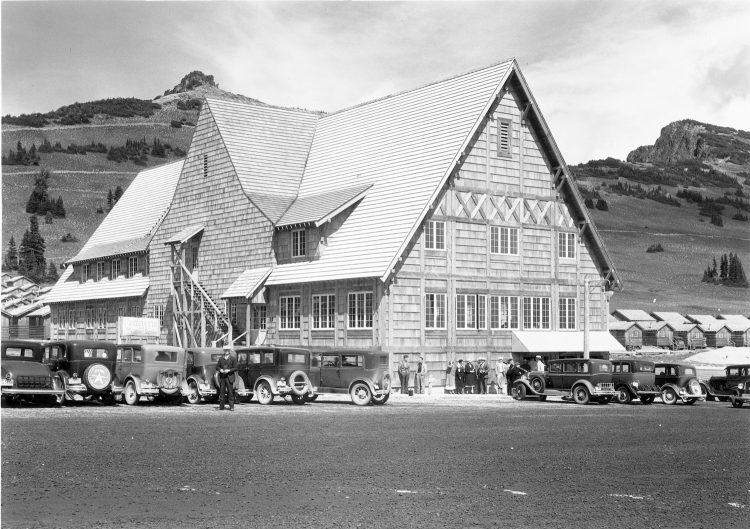
When Mount Rainier became a national park in 1899, there was little regulation over Reese and others doing business in the park. This lack of oversight led to a variety of entrepreneurial schemes, environmental damage, and sanitation issues. To address these problems, Stephen Mather, the first director of the National Park Service, offered a group of Tacoma businessmen an exclusive contract for all guest services in the park. His only requirement was the construction of a first-class resort hotel at Paradise. The businessmen agreed and formed the Rainier National Park Company (RNPC) in 1916. That same year, construction began on the Paradise Inn, which was completed in less than a year at a cost of $91,000. The Inn opened for business in July 1917.
The Paradise Inn was designed by Tacoma architect Frederick Heath, who envisioned a structure that blended seamlessly with its surroundings. The timber used for the interior décor was cut from within the park, not far from the construction site. Three decades earlier, a forest fire had killed a large stand of Alaska yellow cedars. Over time, the trees, still standing, lost their limbs and weathered to a light silver hue. These same trees were transformed into the long pillars and exposed timber frame beams that grace the Inn’s lobby today.
A skilled German artisan, Hans Frahnke, approached the RNPC about creating unique furnishings for the massive lobby. He was hired and spent seven summers and one winter crafting his masterpieces. His remarkable craftsmanship remains on display in the lobby today, including the regal, throne-like cedar chairs, enormous 1,500-pound tables, a Bavarian castle-like piano, a 14-foot-tall grandfather clock, a log façade registration desk, and a bear-shaped mail drop carved from a stump.
When the Paradise Inn first opened, it featured 37 guest rooms and a dining capacity for 400 guests. Recognizing that not everyone could afford the hotel, the RNPC built tent platforms behind the Inn. The Inn proved so popular that in 1920, the RNPC added an annex wing with 104 more rooms. Surprisingly, the Inn’s popularity outpaced that of the tents, leading to the tents’ removal in 1930. They were replaced with 275 cabins, and the Paradise Lodge was constructed to serve as a central service center, complete with a cafeteria, camp store, and 40 additional guest rooms.
However, the prosperity of Paradise was short-lived. The Great Depression, followed by World War II, drastically reduced tourism. Most visitors could no longer afford a room at the Paradise Inn, and even the small cabins saw limited use. Facing serious revenue shortfalls, the RNPC attempted to attract guests with creative ventures, including the construction of a nine-hole golf course behind the Inn. Unfortunately, the course was short-lived, as snow often lingered until late July and returned by September or October.
The decline in visitors during the war prolonged the economic downturn. RNPC closed the Paradise Lodge and, in 1943, sold the cabins for $160 each to real estate companies. The cabins were relocated to help alleviate housing shortages for war industry workers in the Puget Sound area and migrant workers in the Yakima Valley. The RNPC never fully recovered from these economic challenges. Recognizing the essential need for visitor services, the National Park Service (NPS) purchased all RNPC-owned buildings in 1952. In return, the RNPC retained exclusive rights to all concession services in the park.
The Paradise Lodge was burned to the ground in 1965 to make way for more parking, but the NPS remained committed to preserving the Paradise Inn. Listed on the National Register of Historic Places in 1991, the Inn became an integral part of the park’s National Historic Landmark District. It has undergone several rehabilitations, the most significant being a two-year structural upgrade from 2006 to 2007.
Despite many changes over the decades, the Paradise Inn remains a grand testament to its original rustic park hotel style. It stands nearly unchanged from the 1920s, when travelers first sought a place to stay amidst the stunning beauty of Mount Rainier. Visitors from around the world continue to flock to Paradise to witness spectacular views of massive glaciers, meadows lush with wildflowers, and the chance to climb the mountain or explore the park’s 263 miles of trails. Indeed, the name Paradise remains as fitting today as it was when Virinda Longmire first bestowed it upon this glorious alpine wonderland.
For James Longmire, the sight must have been awe-inspiring as he approached Mount Rainier on a crisp morning in 1883. Imagine steam vapor billowing around the ferns and evergreens of the ancient forest, revealing the location of mineral hot springs in a place of extraordinary beauty. Longmire and his companions, George Bayley and P.B. Van Trump, were returning from a successful climb of the mountain when they camped by the Nisqually River. As their horses wandered off, Longmire went in search of them and stumbled upon a meadow filled with bubbling springs. The discovery was too promising to ignore.
Longmire quickly filed a mineral claim for 20 acres, constructed a rudimentary trail, and hand-crafted a small cabin. His family, who had traveled west with him on the Oregon Trail 30 years earlier, soon joined him to build and operate the first tourist inn on Mount Rainier. The rustic accommodations became increasingly popular, and within a few years, they were regularly filled with visitors eager to experience the springs and the surrounding natural beauty.
In the summer of 1890, James Longmire expanded his venture by opening the Longmire Springs Hotel, a modest two-story structure made of split cedar. The hotel featured five small guest rooms on the upper floor and a lobby on the lower level. Several bathhouses were built by digging out springs and sinking tubs into the ground. In addition to the mineral baths, which local Native American tribes believed had curative powers, guests could enjoy mud baths and sulfur plunges.
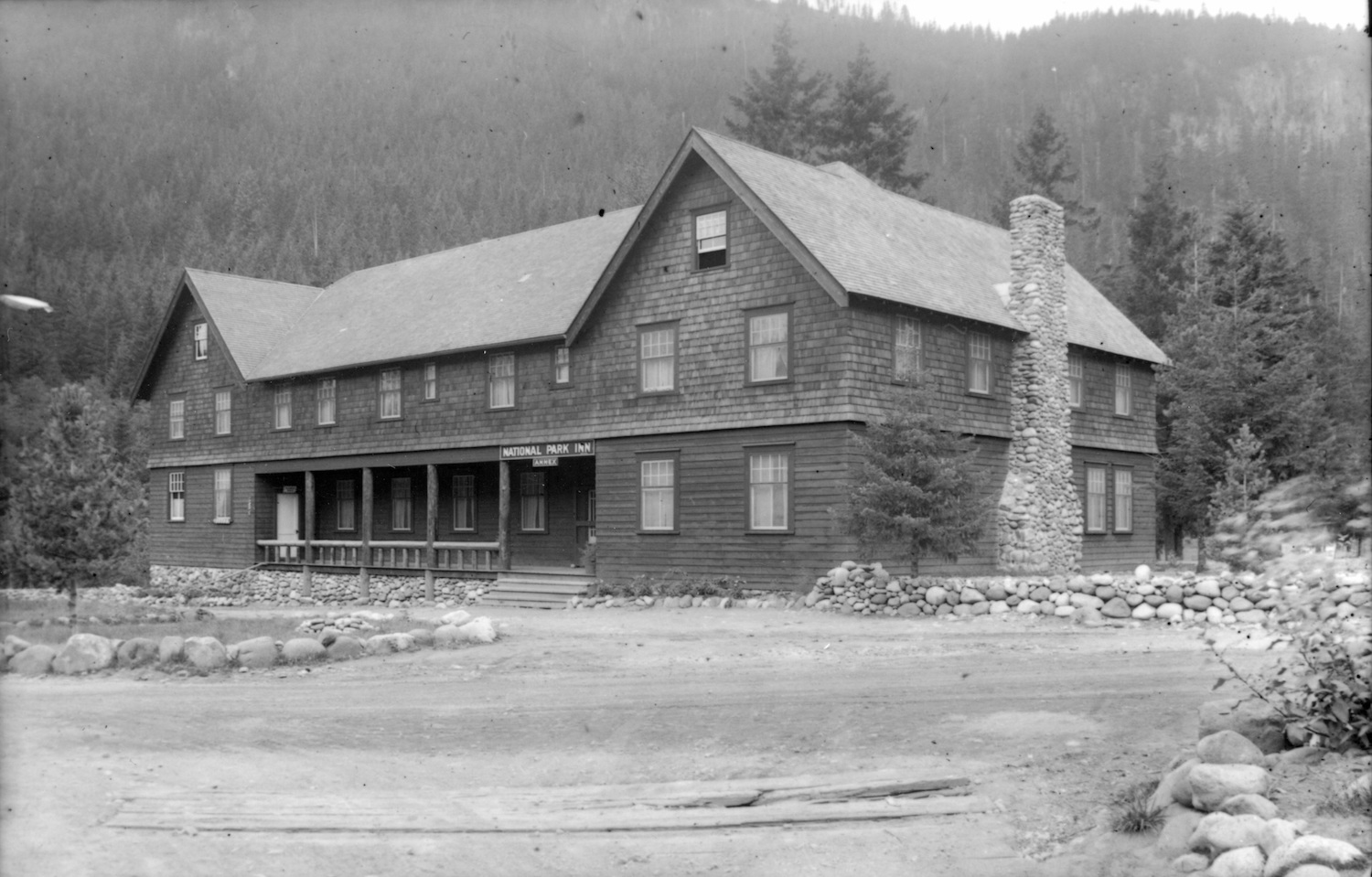
Unfortunately, James Longmire never saw his dream fully realized. He passed away in 1897, just two years before Mount Rainier was designated the fifth national park. The Longmire family’s venture faced its first significant competition in 1906 when the Tacoma Eastern Railroad Company built the National Park Inn, a first-class, three-story resort hotel that accommodated 60 guests.
The greatest boost to park visitation came in 1907, when Mount Rainier became the first national park to permit automobiles. Anyone who could afford a car could also afford the toll—$5.00 per vehicle per year. By 1910, automobile stages were transporting tourists in comfort from the railroad terminal in Ashford to Longmire Springs, further increasing the area’s popularity.
In 1916, the Rainier National Park Company (RNPC) was formed under the encouragement of Stephen Mather, the first director of the National Park Service. Mather’s goal was to consolidate the park’s various vendors under one company contracted by the park. Soon after its formation, the RNPC secured an exclusive 20-year concession contract for the entire park. Within a year, the company completed the Paradise Inn and purchased the Longmire family’s business, including the Longmire Springs Hotel and the National Park Inn, which had previously been owned by the railroad.
The RNPC initially planned to market the hot springs as a health resort but was prohibited by the Park Service after tests revealed that the waters held no medicinal value. As a result, the company decided to burn down the aging Longmire Springs Hotel and relocate a newly built annex next to the National Park Inn. In 1926, fire destroyed the original National Park Inn, but the annex remained untouched. Today, that annex stands as the current National Park Inn.
The RNPC retained control over park concessions until 1952, when they sold their buildings to the National Park Service while maintaining their business contract. In 1968, the RNPC dissolved, and in 1973, Government Services Incorporated took over the concession operations at Mount Rainier National Park. This company, now known as Rainier Guest Services, continues to operate the concession activities at the Paradise Inn, Jackson Visitor Center, National Park Inn, and Sunrise Lodge.
The National Park Inn underwent renovations in both 1936 and 1990. Along with the adjoining General Store, it is now listed on the National Historic Register as part of the Longmire Historic District. Today, the National Park Inn offers 25 guest rooms, a casual dining restaurant, a guest lounge, and a country store. Open year-round, the Inn attracts visitors from around the world who come to enjoy spectacular views, hiking, cross-country skiing, snowshoeing, and its legendary hospitality.
Longmire has undergone many changes since that chilly morning in 1883. The bathhouses, wagon trails, and antiquated facilities are long gone. Yet the lush vegetation, stunning vistas, abundant wildlife, and majestic splendor of Mount Rainier remain, ensuring that Longmire continues to enchant visitors just as it did for James Longmire more than a century ago.
The most stunning views of Mount Rainier are from Sunrise, home to the largest glacier in the contiguous United States, the Emmons Glacier. This massive ice sheet dominates the mountain’s northeast side. The dry, crisp weather typical of the leeward side of mountain ranges often keeps Sunrise clear while clouds shroud other parts of the park. At 6,400 feet, Sunrise is the highest point accessible by vehicle in Mount Rainier National Park. The drive to Sunrise is considered one of the most scenic mountain routes in the country. A popular stop along the way, Sunrise Point, offers panoramic views of five volcanoes: Mount Rainier, Mount Baker, Glacier Peak, Mount Adams, and Mount Hood. For those seeking an iconic sunrise or sunset photograph, Sunrise Point is one of the best spots in the park.
.
Automobiles played a significant role in the growth of park visitation, and Mount Rainier became the first national park to permit automobiles in 1907. Initially, roads were only available on the southwest side, with Paradise as the sole high mountain destination. As Paradise grew increasingly crowded, the public demanded more access to other parts of the park. The National Park Service agreed and looked to the northeast side, where a wagon trail built by a mining company already existed. This rough, one-lane path followed the White River as far as Glacier Basin, and by 1918, adventurous drivers were already using it.
Recognizing the potential for further development, the Rainier National Park Company (RNPC), which held the exclusive contract for park concessions, seized the opportunity. In 1921, they established the White River Camp, located seven miles up the road. Working closely with the Park Service, the RNPC planned a new visitor destination in a subalpine meadow above the White River known as Yakima Park.
The Park Service and the RNPC collaborated to create an elaborate development plan for Sunrise. This included a state-of-the-art road featuring scenic turnouts, rustic guardrails, and stone-covered bridges. Completed in 1930, the road was accompanied by the construction of a power plant, water supply, and sewage system by the Park Service. Meanwhile, the RNPC planned to build a grand mountain resort, including a 300-room hotel and 600 cabins.
However, the economic downturn of 1930 made it difficult for the RNPC to secure investors. They initially hoped the railroads would fund their $2 million project, but they were disappointed to receive only a small token contribution. Despite limited funding, they borrowed heavily and moved forward with construction. When Sunrise officially opened on July 15, 1931, there was no grand hotel, only 215 cabins and the Sunrise Lodge, which served as a central service hub. The lodge housed a cafeteria, camp store, post office, storage rooms, and employee dormitories.
Throngs of tourists flocked to Sunrise after its opening, with weekend visitation often surpassing that of Paradise. Park officials initially believed that Sunrise would eventually double Paradise’s visitation, but this prediction never materialized. Once the novelty of the new road wore off, visitor numbers stabilized at about half the levels seen at Paradise.
During the 1930s and early 1940s, the Civilian Conservation Corps (CCC) significantly enhanced the park’s infrastructure. They developed an extensive network of hiking trails radiating from Sunrise, many of which remain popular today, offering easy access to alpine meadows and breathtaking views of Mount Rainier’s north face and its massive glaciers.
The RNPC faced significant debt from its Sunrise developments, while the Great Depression further reduced visitor spending. To attract more business, the company marketed Sunrise as a dude ranch, fabricating stories about lost gold mines and shootouts between lawmen and cattle rustlers. Though these tales were purely promotional, the Park Service reinforced the frontier theme by designing new administrative buildings in a blockhouse style reminiscent of early pioneer fortifications.
Despite the economic struggles, park visitation increased by 71% during the 1930s. However, visitors spent more on transportation than on lodging, food, and services. Rather than paying for the RNPC’s guided tours, most tourists opted for the free ranger-led nature walks and lectures offered by the Park Service. In 1934, a free public campground and picnic area were established near Shadow Lake, less than a mile from Sunrise Plaza.
The cabins at Sunrise proved unpopular and struggled to withstand the harsh high elevation climate. In 1944, the cabins were sold to real estate companies for $110 each and relocated to address housing shortages among war industry workers in the Puget Sound area and migrant farmers in the Yakima Valley.
Today, no overnight accommodations remain at Sunrise. The Sunrise Lodge, now operated by Rainier Guest Services, offers cafeteria-style dining, a gift shop, and a bookstore. One of the original blockhouses has been remodeled into a visitor center.
The season at Sunrise is brief, running from early July through mid-September. Severe mountain weather and the high cost of road maintenance make it impractical to keep the area open year-round. If you visit the park during the summer, Sunrise is a must-see destination. Its unparalleled views, pristine hiking trails, and rich history make it one of the most unforgettable experiences Mount Rainier National Park has to offer.